'81 Shobud Super Pro
Moderator: Dave Mudgett
-
Nathan Laudenbach
- Posts: 254
- Joined: 29 Oct 2015 9:39 pm
- Location: Montana
- State/Province: Montana
- Country: United States
'81 Shobud Super Pro
I just acquired a 1981 Shobud Super Pro. My first pedal steel. It sat in the case for a few years and is in pretty nice shape and seems to be in tune or close to it. I know it's all original. Can someone here please tell me what the under carriage is? I assumed it is the rack and barrel system, but after doing forum and web searches for a couple days I can't find anything definite on an Super Pro from 1981. Hopefully I get a lot of responses and opinions, I can nerd out on this stuff all day! Thanks!
-
Lee Dassow

- Posts: 847
- Joined: 17 Mar 2010 8:01 am
- Location: Jefferson, Georgia USA
- State/Province: Georgia
- Country: United States
I'm not sure but I dont think they had rack and barrel
in 1981. Maybe a picture of the underside would help. Tenn.Lee
in 1981. Maybe a picture of the underside would help. Tenn.Lee
2015 Mullen D-10 Royal Precision 9x8,-1990 BMI S-10 5x5-1972 Silver face Fender pro Reverb amp,-1965 Fender Super Reverb Amp,- 1966 Fender Showman Amp Two 15" JBL speakers,- 2006 65 Fender Twin Reverb reissue Amp,- 1982 Peavey Session 500 amp,-1978 Peavey Session 400,Goodrich Volume Pedals,John Pearse Steel Bars,
-
Paul Wade

- Posts: 5701
- Joined: 27 Aug 2003 12:01 am
- Location: mundelein,ill
- State/Province: -
- Country: United States
shobud super pro
super pro is all pull
Press J to jump to the feed. Press question mark to learn the rest of the keyboard shortcuts
Search within r/Guitar
Subreddit Iconr/Guitar
Log In
Sign Up
Found the internet!
7
the Steel Guitar Network - Field Guide to Sho-Bud Pedal Steel Guitars
7
Posted by6 years ago
the Steel Guitar Network - Field Guide to Sho-Bud Pedal Steel Guitars
Field Guide to Sho-Bud Pedal Steel Guitars
Compiled by Duane Becker
The following lists briefly the different models of pedal steels that Sho-Bud produced through the years.
The dates given for one particular model sometimes overlap into the dates of another model. For example, the Permanent model was continued to be built and sold for a number of years well into the Fingertip era.
Every effort has been made to assure accuracy in the dates and information given. This in itself has been extremely difficult to do because nothing has never been published or written about Sho-Bud, whether it be the company or the models of pedal steels-other than the individual brochures from Sho-Bud. What I had to rely on was employees memories, and those memories are fading fast. Basically its been more than 20 years ago since this stuff happened and its reasonable to assume that people may not remember details that far back in time.
As I compiled the information, I often encountered conflicts in details and facts. I attempted to resolve the conflict by the corroboration of at least three sources. If confirmation was impossible and not critical to the presentation of the material, the information was either excluded or an approximation noted. Volumes could be written about Sho-Bud, and what is presented here is by no means a finished work.
I am continually adding to my notes and information about Sho-Bud. Attempts to contact long time employees and Jackson family members to interview will continue and the information presented here will be updated and added to when needed.
Duane Becker 2747 Willms Rd. Elk, WA. 99009 509-292-0109 email: dhb60@centurylink.net
The Sho-Bud Models in Chronological Order
THE PERMANENT These were the first pedal steels built by Sho-Bud. Starting out in 1957, Shot Jackson and Buddy Emmons began building cabinets and assembling the pedal mechanism in Madison, Tennessee, just north of Nashville. The cabinets of the first several Permanents were all wood with no metal end plates. Soon after though metal end plates were added to the production. The undercarriage parts were welded together and the pedal setups, unlike today, could not be changed. Eight string, and later nine string cabinets were made with pedals, and by late 1958, the three pedals that we know today on the E9, became standard. Shortly after, the permanent model evolved to the standard ten string. The early permanents had no knee levers and basically consisted of raises only on the pedals(which is still the standard E9 three pedal setup today). During the late 1950's and early 1960's, the C6 neck was also evolving, with the Nashville players adding pedals and strings to eventually becoming standard with 10 strings and 5 pedals. As a result, the double neck soon became the norm and many permanent double necks with pedals were produced through these years. It was not uncommon to see a single neck permanent as well. These pedal steels were very well received by the steel players and became very popular. The permanent, sometimes called the Custom, continued to be produced well into the 1960's. Although Shot Jackson and others were adding knee levers to existing steels since the early 1950's, knee levers were pretty much standard on the Sho-Buds by 1964. Even earlier than this, around 1962 or '63, knee levers were starting to gain in popularity.
Up to this time, steel players sat on a regular chair, piano stool, or bench. With the addition of the knee levers, players found it sometimes difficult to set at the pedal steel and reach the knee levers and pedals all at the same time. Long time Sho-Bud employee, Duane Marrs came up with the idea of a seat specially designed for the pedal steel guitarist. Some what higher than the average chair or stool, this seat was the perfect height for playing the pedal steel. Duane Marrs built a prototype seat that included a storage compartment and called it the pack-a-seat. When Duane approached Shot Jackson about the idea of manufacturing the pack-a-seat that he had invented, they figured out that they would have to charge no less than $35 to cover the expenses to build it. No one thought that the steel players would be interested in such a seat, nor would be willing to pay money for it. But to their surprise, the seat was well received and as knee levers were added to the pedal steels, sales of the pack-a-seat increased and soon became, and still is today, a much needed accessory for the pedal steel guitar.
In Shot's old catalog, the number of necks, strings and pedals affected the price of the Permanent model, because these pedal steels were for the most part, custom built. For a double neck 10 string the price was $480, with extra pedals, $50 each.
2) THE FINGERTIP Around 1963, production started on the Sho-Bud Fingertip. This model was unique because unlike the Permanent, it was possible to change the pedal setup. It was nicknamed the Universal for this reason, and was basically the start of the all-pull undercarriage system. The Fingertip got its name from the fact that you could tune the pedal raises or lowers with your fingertips. On the end of the changer, slotted, finger turntable screws for each of the strings was used to tune the pedals. The changer was designed in such a way that you could raise and lower the same string if so desired. Additional raises or lowers of the same string had to be adjusted in the undercarriage. Although the setup was easy to change, the guitar was very sensitive. It had to be setup and adjusted perfectly in order to stay in tune. Constant adjustment was pretty much a given. But once it was adjusted correctly, it played and sounded great. It had a wonderful tone. Generally, the Fingertip was standard with one, and then later, two knee levers. In 1964, the Jackson family moved the Sho-Bud company to lower Broadway in downtown Nashville. A full service music store featuring Sho-Bud pedal steels and products was offered. Fingertips and Permanents were built and assembled at this store on lower Broadway. The generally accepted era for the Fingertip was from 1963 to around 1967 or possibly later. Suggested prices for these Fingertips during their production run varied from eight to twelve string; single,double, or triple neck. The type of wood and finish, plus any wood inlay work also affected the price. As the Permanent, the Fingertip was considered a custom pedal steel. But for an example, a double-10 listed at $620 and $50 for each additional pedal or knee lever.
3) THE BALDWIN CROSSOVER Sho-Bud became involved with the Baldwin Piano and Organ Company because of its large distribution potential. Baldwin wanted Sho-Bud to produce a pedal steel with their name on it to promote sales, and in 1967 the Baldwin Crossover was introduced. This model of pedal steel like the Fingertip had a wonderful rich tone. The guitar was standard with 6 pedals and one knee lever (generally placed on the right knee), although at this time, players were adding knee levers on a regular basis, and it was not uncommon to see two or even three knee levers. The Baldwin Crossover was a double neck with a shift type lever or gear that the player could move. In one position all the pedals would operate the top neck. Moving the shift lever would disengage the pedals from the top neck to the bottom neck(by moving the shift lever, the pedals "crossed over" to the other neck, thus the term "crossover"). In this way, all the pedals could actually be used on both necks just by the flick of the shift lever. This shift lever was positioned on the back side of the pedal steel facing the player. The undercarriage of the Baldwin Crossover was unique in the fact that the pull rods were attached to small metal "baskets". These baskets were connected to the pedal crossrods and bell crank. The guitar had a metal frame that wrapped all the way around the body of the steel. On the front, the frame was on the inside of the body and the actual front was covered with maple. This wrap around metal frame supported the undercarriage. There were two models of Baldwin Crossover available. One was the Regular Baldwin Crossover in which the metal frame was an unpolished black textured-ruff finish. The other model, called the Custom Baldwin Crossover had a smooth polished metal frame. These Baldwins like the Fingertip was sensitive and temperamental in the fact that the tuning and pedal setup up had to be adjusted perfectly in order for it to play right and in tune. When this was done and the guitars were adjusted, both the Fingertip and the Baldwin Crossover played great. The generally excepted Crossover production years were from 1967 to 1970. Suggested retail price of a double neck 10 string, six pedals and one knee lever was$1295 for the maple body in 1970.
4) THE PROFESSIONAL Around 1970, Sho-Bud introduced the Professional model of pedal steel. The same basic undercarriage design using the small metal baskets on the Baldwin Crossover was used on the Professional model. The Professional was also very similar to the Crossover except having the metal frame and crossover removed. The Professional had a wonderful rich and warm tone. The Professional production era was from 1970 to 1973, and the suggested price at this time was $1450.
5) THE PRO SERIES Sho-Bud introduced the Pro Series approximately late 1972 with the Pro-II. Although the Pro-I had been around for some time, considered by many to be just a single neck Professional, it was soon called the Pro-I. The Pro-I was standard first with three pedals and one knee lever. The Pro-I and II were a very popular pedal steel for Sho-Bud, however, the Professional model continued to be produced well into 1974. The undercarriage of the Pro II featured rods and bellcranks that replaced the baskets on the Professional model. The early Pro Series as well as the early LDG models used a single raise-single lower changer with any additional raise or lower of the same string provided by a brass tuning collar on the rod. Later the Pro-II employed a double raise-single lower changer. In 1975, Sho-Bud introduced the Pro-III featuring metal necks. The standard changer on the Pro-III was a double raise-double lower. Also, in 1975, the Pro Series body designed changed from a rounded body front to a square front. The floor pedals also changed to a narrow design. This was the start of the Pro/Custom series. Also during this time a new nylon rod tuning changer was introduced on the Pros. This enabled the player to tune all of the pedal/knee raises and lowers at the right end plate which was a great improvement over the changer and undercarriage of the past. As was stated, the Pro-I had been around a number of years before the Pro-II and Pro-III. In the early 1970's, Sho-Buds suggested price list for the Pro-I was $995. In 1976 the Pro-I Custom listed $895 retail. Gretsch in 1981 listed the Pro-I for $1450. The Pro-II in the early 70's listed at $1595. In the 1976 catalog the Pro-II was $1595 retail and the 1981 Gretsch catalog suggested price was $2120. The Pro-III first produced in 1975, had a retail price of $1795 for the Pro-III Custom in 1976, and Gretsch listed it for $2350 in 1981.
6) MAVERICK Want a pedal steel guitar for just $400? Sho-Buds answer was the Maverick. Designed with 3 foot pedals and one knee lever, the player of this single 10 string model could get most of the Nashville pedal steel sounds. Production started in the very early 1970's and this model was designed with the beginner in mind. The changer and undercarriage was based on the old permanent system and could not be changed. The three foot pedals were standard E9 changes and the one knee lever standard lowered the second string and eighth string one half tone. The first production Mavericks had a solid birdseye maple body with clear lacquer finish, and a raised wood neck with the regular tear drop keyhead. Almost all of these early Mavericks were the clear (blonde) natural finish. Later though, Sho-Bud came up with a way to cut the cost of building the Maverick by covering the unfinished body with a brown wood grained covering. The tear drop keyhead was also changed to an ash tray style keyhead. The Mavericks were popular and many were produced through the years. These models were built pretty much continually from the early 70's on. In the early 1970's, Sho-Buds suggested price for the solid birdseye maple style was $425. A later catalog lists the price for $395. The 1976 catalog suggested price list for the wood grained covered Maverick was $360 retail. Its interesting to note that the Gretsch Company's suggested price list for the same wood grained covered Maverick was $790 in 1981.
7) LDG Production started around 1973. The idea came from Lloyd Green in the fact that he was not playing the C6 neck too much and wanted the back neck and C6 pedals removed to decrease weight. A soft foam pad was put on the back neck as an arm rest. The first LDG's were basically early Pro-II with the pad installed. Later, the body, undercarriage, changer, and mechanics evolved over time with the Pro-Series and then the Super Pro. The early 1970's suggested price list for an LDG was $1195. The 1976 catalog lists the price at $1195 retail, and Gretsch in 1981 list price was $1720.
 FENDER/SHO-BUD In the early 1970's the Fender Guitar Company contracted Sho-Bud to produce a Fender/Sho-Bud pedal steel. This model and the Super Pro were very similar in design except for the body and the key head. The undercarriage was basically the same as used on the future Super Pro. These Fender/Sho-Bud pedal steels had the ash tray Fender style keyhead. The changer used was a triple raise-double lower, and was similar to the Super Pro changer. Other then the changer and undercarriage, this model had a look that was different then the regular Sho-Buds.
9) SUPER PRO In 1977, the Super Pro was introduced. It was standard as a double wood or metal neck, with 8 pedals and 6 knee levers. This model and the Fender/ShoBud was very similar in design except for the body and the key head. The Super Pro had a streamlined-smaller and thinner body design then the Sho-Bud models of the past. Also, the undercarriage pretty much the same as the Fender/Sho-Bud model, was very different then the past Sho-Bud models. The cross rods on the past models were round. On the Super Pro they were hex shaped. The bell cranks and pedal rods were also of a new design. Small metal tuning rod clips were used to hold the tuning rods onto the bell crank. The floor pedals on the Super Pro were small narrow pedals that had a very different look then the past wide pedal design. The knee lever design changed as well, to a straight narrow lever. The tuning key head was square and blunt on the end instead of the old standard tear drop key head of the past. Clearly, Sho-Bud had a new pedal steel. This new undercarriage design was very popular. After the introduction of the Super Pro, the undercarriage designs of the Pro-Series and the LDG pedal steels changed to the Super Pro style. When the Super Pro was first introduced in 1977, the retail price was $2175. Gretsch in 1981 listed the Super Pro at $2850.
11) SHO-BUD KEYLESS Although this model was never really produced by Sho-Bud, it is mentioned here because several prototype Keyless pedal steels (Single-10) were made. The Keyless was built to eliminate the raise and lower changer mechanism by using permanent changer fingers at both ends of the guitar. One end to raise and the other end to lower. The Keyless guitar idea never caught on with Sho-Bud and the idea was dropped. Had Sho-Bud continued with the development of the Keyless, they would have no doubt, been successful. Today, many pedal steel manufactures offer keyless models that play and sound great.
12) SUPER PRO II After the Jackson family sold the Sho-Bud company to Gretsch in 1979, Gretsch came out with a modified version of the Super Pro. Not exactly considered a production run, several Super-Pro-II's were built by the Gretsch company around 1984. The Gretsch price list from 1983 lists the Super Pro-II as a double 10 string, 8 pedals, 6 knee levers with a suggested price of $3530
MODEL NUMBERS FOR SHO-BUD PEDAL STEEL GUITARS
6138 Single Neck 10 strings 3 pedals
6139 Single Neck 10 strings 3 pedals, 1 knee lever
6140 Single Neck 10 strings 6 pedals, no knee lever
6141 Double Neck 6 pedals, 1 knee lever-maple body
6142 Double Neck 6 pedals, 1 knee lever-rosewood body
6143 Professional Model Double Neck 10 strings 8 pedals, 2 knee levers
6148 Pro-I Single Neck 10 strings 3 pedals, 2 knee levers
6150 LDG Single Neck 10 strings 3 pedals, 4 knee levers
6152 Maverick Single Neck 10 strings 3 pedals, 1 knee lever
6155 Pro-II Double Neck 10 strings 8 pedals, 2 knee levers
6160 Pro-I Single Neck 12 string 3 pedals, 4 knee levers
6164 Pro-III Double Neck 10 strings 8 pedals, 4 knee levers
6165 Pro-II Double Neck 12 strings 8 pedals, 4 knee levers
6166 Super Pro Double Neck 10 strings 8 pedals, 6 knee levers
0 comments
99% Upvoted
This thread is archived
New comments cannot be posted and votes cannot be cast
no comments yet
Be the first to share what you think!
More posts from the Guitar community
Continue browsing in r/Guitar
Press J to jump to the feed. Press question mark to learn the rest of the keyboard shortcuts
Search within r/Guitar
Subreddit Iconr/Guitar
Log In
Sign Up
Found the internet!
7
the Steel Guitar Network - Field Guide to Sho-Bud Pedal Steel Guitars
7
Posted by6 years ago
the Steel Guitar Network - Field Guide to Sho-Bud Pedal Steel Guitars
Field Guide to Sho-Bud Pedal Steel Guitars
Compiled by Duane Becker
The following lists briefly the different models of pedal steels that Sho-Bud produced through the years.
The dates given for one particular model sometimes overlap into the dates of another model. For example, the Permanent model was continued to be built and sold for a number of years well into the Fingertip era.
Every effort has been made to assure accuracy in the dates and information given. This in itself has been extremely difficult to do because nothing has never been published or written about Sho-Bud, whether it be the company or the models of pedal steels-other than the individual brochures from Sho-Bud. What I had to rely on was employees memories, and those memories are fading fast. Basically its been more than 20 years ago since this stuff happened and its reasonable to assume that people may not remember details that far back in time.
As I compiled the information, I often encountered conflicts in details and facts. I attempted to resolve the conflict by the corroboration of at least three sources. If confirmation was impossible and not critical to the presentation of the material, the information was either excluded or an approximation noted. Volumes could be written about Sho-Bud, and what is presented here is by no means a finished work.
I am continually adding to my notes and information about Sho-Bud. Attempts to contact long time employees and Jackson family members to interview will continue and the information presented here will be updated and added to when needed.
Duane Becker 2747 Willms Rd. Elk, WA. 99009 509-292-0109 email: dhb60@centurylink.net
The Sho-Bud Models in Chronological Order
THE PERMANENT These were the first pedal steels built by Sho-Bud. Starting out in 1957, Shot Jackson and Buddy Emmons began building cabinets and assembling the pedal mechanism in Madison, Tennessee, just north of Nashville. The cabinets of the first several Permanents were all wood with no metal end plates. Soon after though metal end plates were added to the production. The undercarriage parts were welded together and the pedal setups, unlike today, could not be changed. Eight string, and later nine string cabinets were made with pedals, and by late 1958, the three pedals that we know today on the E9, became standard. Shortly after, the permanent model evolved to the standard ten string. The early permanents had no knee levers and basically consisted of raises only on the pedals(which is still the standard E9 three pedal setup today). During the late 1950's and early 1960's, the C6 neck was also evolving, with the Nashville players adding pedals and strings to eventually becoming standard with 10 strings and 5 pedals. As a result, the double neck soon became the norm and many permanent double necks with pedals were produced through these years. It was not uncommon to see a single neck permanent as well. These pedal steels were very well received by the steel players and became very popular. The permanent, sometimes called the Custom, continued to be produced well into the 1960's. Although Shot Jackson and others were adding knee levers to existing steels since the early 1950's, knee levers were pretty much standard on the Sho-Buds by 1964. Even earlier than this, around 1962 or '63, knee levers were starting to gain in popularity.
Up to this time, steel players sat on a regular chair, piano stool, or bench. With the addition of the knee levers, players found it sometimes difficult to set at the pedal steel and reach the knee levers and pedals all at the same time. Long time Sho-Bud employee, Duane Marrs came up with the idea of a seat specially designed for the pedal steel guitarist. Some what higher than the average chair or stool, this seat was the perfect height for playing the pedal steel. Duane Marrs built a prototype seat that included a storage compartment and called it the pack-a-seat. When Duane approached Shot Jackson about the idea of manufacturing the pack-a-seat that he had invented, they figured out that they would have to charge no less than $35 to cover the expenses to build it. No one thought that the steel players would be interested in such a seat, nor would be willing to pay money for it. But to their surprise, the seat was well received and as knee levers were added to the pedal steels, sales of the pack-a-seat increased and soon became, and still is today, a much needed accessory for the pedal steel guitar.
In Shot's old catalog, the number of necks, strings and pedals affected the price of the Permanent model, because these pedal steels were for the most part, custom built. For a double neck 10 string the price was $480, with extra pedals, $50 each.
2) THE FINGERTIP Around 1963, production started on the Sho-Bud Fingertip. This model was unique because unlike the Permanent, it was possible to change the pedal setup. It was nicknamed the Universal for this reason, and was basically the start of the all-pull undercarriage system. The Fingertip got its name from the fact that you could tune the pedal raises or lowers with your fingertips. On the end of the changer, slotted, finger turntable screws for each of the strings was used to tune the pedals. The changer was designed in such a way that you could raise and lower the same string if so desired. Additional raises or lowers of the same string had to be adjusted in the undercarriage. Although the setup was easy to change, the guitar was very sensitive. It had to be setup and adjusted perfectly in order to stay in tune. Constant adjustment was pretty much a given. But once it was adjusted correctly, it played and sounded great. It had a wonderful tone. Generally, the Fingertip was standard with one, and then later, two knee levers. In 1964, the Jackson family moved the Sho-Bud company to lower Broadway in downtown Nashville. A full service music store featuring Sho-Bud pedal steels and products was offered. Fingertips and Permanents were built and assembled at this store on lower Broadway. The generally accepted era for the Fingertip was from 1963 to around 1967 or possibly later. Suggested prices for these Fingertips during their production run varied from eight to twelve string; single,double, or triple neck. The type of wood and finish, plus any wood inlay work also affected the price. As the Permanent, the Fingertip was considered a custom pedal steel. But for an example, a double-10 listed at $620 and $50 for each additional pedal or knee lever.
3) THE BALDWIN CROSSOVER Sho-Bud became involved with the Baldwin Piano and Organ Company because of its large distribution potential. Baldwin wanted Sho-Bud to produce a pedal steel with their name on it to promote sales, and in 1967 the Baldwin Crossover was introduced. This model of pedal steel like the Fingertip had a wonderful rich tone. The guitar was standard with 6 pedals and one knee lever (generally placed on the right knee), although at this time, players were adding knee levers on a regular basis, and it was not uncommon to see two or even three knee levers. The Baldwin Crossover was a double neck with a shift type lever or gear that the player could move. In one position all the pedals would operate the top neck. Moving the shift lever would disengage the pedals from the top neck to the bottom neck(by moving the shift lever, the pedals "crossed over" to the other neck, thus the term "crossover"). In this way, all the pedals could actually be used on both necks just by the flick of the shift lever. This shift lever was positioned on the back side of the pedal steel facing the player. The undercarriage of the Baldwin Crossover was unique in the fact that the pull rods were attached to small metal "baskets". These baskets were connected to the pedal crossrods and bell crank. The guitar had a metal frame that wrapped all the way around the body of the steel. On the front, the frame was on the inside of the body and the actual front was covered with maple. This wrap around metal frame supported the undercarriage. There were two models of Baldwin Crossover available. One was the Regular Baldwin Crossover in which the metal frame was an unpolished black textured-ruff finish. The other model, called the Custom Baldwin Crossover had a smooth polished metal frame. These Baldwins like the Fingertip was sensitive and temperamental in the fact that the tuning and pedal setup up had to be adjusted perfectly in order for it to play right and in tune. When this was done and the guitars were adjusted, both the Fingertip and the Baldwin Crossover played great. The generally excepted Crossover production years were from 1967 to 1970. Suggested retail price of a double neck 10 string, six pedals and one knee lever was$1295 for the maple body in 1970.
4) THE PROFESSIONAL Around 1970, Sho-Bud introduced the Professional model of pedal steel. The same basic undercarriage design using the small metal baskets on the Baldwin Crossover was used on the Professional model. The Professional was also very similar to the Crossover except having the metal frame and crossover removed. The Professional had a wonderful rich and warm tone. The Professional production era was from 1970 to 1973, and the suggested price at this time was $1450.
5) THE PRO SERIES Sho-Bud introduced the Pro Series approximately late 1972 with the Pro-II. Although the Pro-I had been around for some time, considered by many to be just a single neck Professional, it was soon called the Pro-I. The Pro-I was standard first with three pedals and one knee lever. The Pro-I and II were a very popular pedal steel for Sho-Bud, however, the Professional model continued to be produced well into 1974. The undercarriage of the Pro II featured rods and bellcranks that replaced the baskets on the Professional model. The early Pro Series as well as the early LDG models used a single raise-single lower changer with any additional raise or lower of the same string provided by a brass tuning collar on the rod. Later the Pro-II employed a double raise-single lower changer. In 1975, Sho-Bud introduced the Pro-III featuring metal necks. The standard changer on the Pro-III was a double raise-double lower. Also, in 1975, the Pro Series body designed changed from a rounded body front to a square front. The floor pedals also changed to a narrow design. This was the start of the Pro/Custom series. Also during this time a new nylon rod tuning changer was introduced on the Pros. This enabled the player to tune all of the pedal/knee raises and lowers at the right end plate which was a great improvement over the changer and undercarriage of the past. As was stated, the Pro-I had been around a number of years before the Pro-II and Pro-III. In the early 1970's, Sho-Buds suggested price list for the Pro-I was $995. In 1976 the Pro-I Custom listed $895 retail. Gretsch in 1981 listed the Pro-I for $1450. The Pro-II in the early 70's listed at $1595. In the 1976 catalog the Pro-II was $1595 retail and the 1981 Gretsch catalog suggested price was $2120. The Pro-III first produced in 1975, had a retail price of $1795 for the Pro-III Custom in 1976, and Gretsch listed it for $2350 in 1981.
6) MAVERICK Want a pedal steel guitar for just $400? Sho-Buds answer was the Maverick. Designed with 3 foot pedals and one knee lever, the player of this single 10 string model could get most of the Nashville pedal steel sounds. Production started in the very early 1970's and this model was designed with the beginner in mind. The changer and undercarriage was based on the old permanent system and could not be changed. The three foot pedals were standard E9 changes and the one knee lever standard lowered the second string and eighth string one half tone. The first production Mavericks had a solid birdseye maple body with clear lacquer finish, and a raised wood neck with the regular tear drop keyhead. Almost all of these early Mavericks were the clear (blonde) natural finish. Later though, Sho-Bud came up with a way to cut the cost of building the Maverick by covering the unfinished body with a brown wood grained covering. The tear drop keyhead was also changed to an ash tray style keyhead. The Mavericks were popular and many were produced through the years. These models were built pretty much continually from the early 70's on. In the early 1970's, Sho-Buds suggested price for the solid birdseye maple style was $425. A later catalog lists the price for $395. The 1976 catalog suggested price list for the wood grained covered Maverick was $360 retail. Its interesting to note that the Gretsch Company's suggested price list for the same wood grained covered Maverick was $790 in 1981.
7) LDG Production started around 1973. The idea came from Lloyd Green in the fact that he was not playing the C6 neck too much and wanted the back neck and C6 pedals removed to decrease weight. A soft foam pad was put on the back neck as an arm rest. The first LDG's were basically early Pro-II with the pad installed. Later, the body, undercarriage, changer, and mechanics evolved over time with the Pro-Series and then the Super Pro. The early 1970's suggested price list for an LDG was $1195. The 1976 catalog lists the price at $1195 retail, and Gretsch in 1981 list price was $1720.
FENDER/SHO-BUD In the early 1970's the Fender Guitar Company contracted Sho-Bud to produce a Fender/Sho-Bud pedal steel. This model and the Super Pro were very similar in design except for the body and the key head. The undercarriage was basically the same as used on the future Super Pro. These Fender/Sho-Bud pedal steels had the ash tray Fender style keyhead. The changer used was a triple raise-double lower, and was similar to the Super Pro changer. Other then the changer and undercarriage, this model had a look that was different then the regular Sho-Buds.9) SUPER PRO In 1977, the Super Pro was introduced. It was standard as a double wood or metal neck, with 8 pedals and 6 knee levers. This model and the Fender/ShoBud was very similar in design except for the body and the key head. The Super Pro had a streamlined-smaller and thinner body design then the Sho-Bud models of the past. Also, the undercarriage pretty much the same as the Fender/Sho-Bud model, was very different then the past Sho-Bud models. The cross rods on the past models were round. On the Super Pro they were hex shaped. The bell cranks and pedal rods were also of a new design. Small metal tuning rod clips were used to hold the tuning rods onto the bell crank. The floor pedals on the Super Pro were small narrow pedals that had a very different look then the past wide pedal design. The knee lever design changed as well, to a straight narrow lever. The tuning key head was square and blunt on the end instead of the old standard tear drop key head of the past. Clearly, Sho-Bud had a new pedal steel. This new undercarriage design was very popular. After the introduction of the Super Pro, the undercarriage designs of the Pro-Series and the LDG pedal steels changed to the Super Pro style. When the Super Pro was first introduced in 1977, the retail price was $2175. Gretsch in 1981 listed the Super Pro at $2850.
11) SHO-BUD KEYLESS Although this model was never really produced by Sho-Bud, it is mentioned here because several prototype Keyless pedal steels (Single-10) were made. The Keyless was built to eliminate the raise and lower changer mechanism by using permanent changer fingers at both ends of the guitar. One end to raise and the other end to lower. The Keyless guitar idea never caught on with Sho-Bud and the idea was dropped. Had Sho-Bud continued with the development of the Keyless, they would have no doubt, been successful. Today, many pedal steel manufactures offer keyless models that play and sound great.
12) SUPER PRO II After the Jackson family sold the Sho-Bud company to Gretsch in 1979, Gretsch came out with a modified version of the Super Pro. Not exactly considered a production run, several Super-Pro-II's were built by the Gretsch company around 1984. The Gretsch price list from 1983 lists the Super Pro-II as a double 10 string, 8 pedals, 6 knee levers with a suggested price of $3530
MODEL NUMBERS FOR SHO-BUD PEDAL STEEL GUITARS
6138 Single Neck 10 strings 3 pedals
6139 Single Neck 10 strings 3 pedals, 1 knee lever
6140 Single Neck 10 strings 6 pedals, no knee lever
6141 Double Neck 6 pedals, 1 knee lever-maple body
6142 Double Neck 6 pedals, 1 knee lever-rosewood body
6143 Professional Model Double Neck 10 strings 8 pedals, 2 knee levers
6148 Pro-I Single Neck 10 strings 3 pedals, 2 knee levers
6150 LDG Single Neck 10 strings 3 pedals, 4 knee levers
6152 Maverick Single Neck 10 strings 3 pedals, 1 knee lever
6155 Pro-II Double Neck 10 strings 8 pedals, 2 knee levers
6160 Pro-I Single Neck 12 string 3 pedals, 4 knee levers
6164 Pro-III Double Neck 10 strings 8 pedals, 4 knee levers
6165 Pro-II Double Neck 12 strings 8 pedals, 4 knee levers
6166 Super Pro Double Neck 10 strings 8 pedals, 6 knee levers
0 comments
99% Upvoted
This thread is archived
New comments cannot be posted and votes cannot be cast
no comments yet
Be the first to share what you think!
More posts from the Guitar community
Continue browsing in r/Guitar
-
Nathan Laudenbach
- Posts: 254
- Joined: 29 Oct 2015 9:39 pm
- Location: Montana
- State/Province: Montana
- Country: United States
-
Jerry Overstreet

- Posts: 14890
- Joined: 11 Jul 2000 12:01 am
- Location: Louisville
- State/Province: Kentucky
- Country: United States
Pic from the forum:
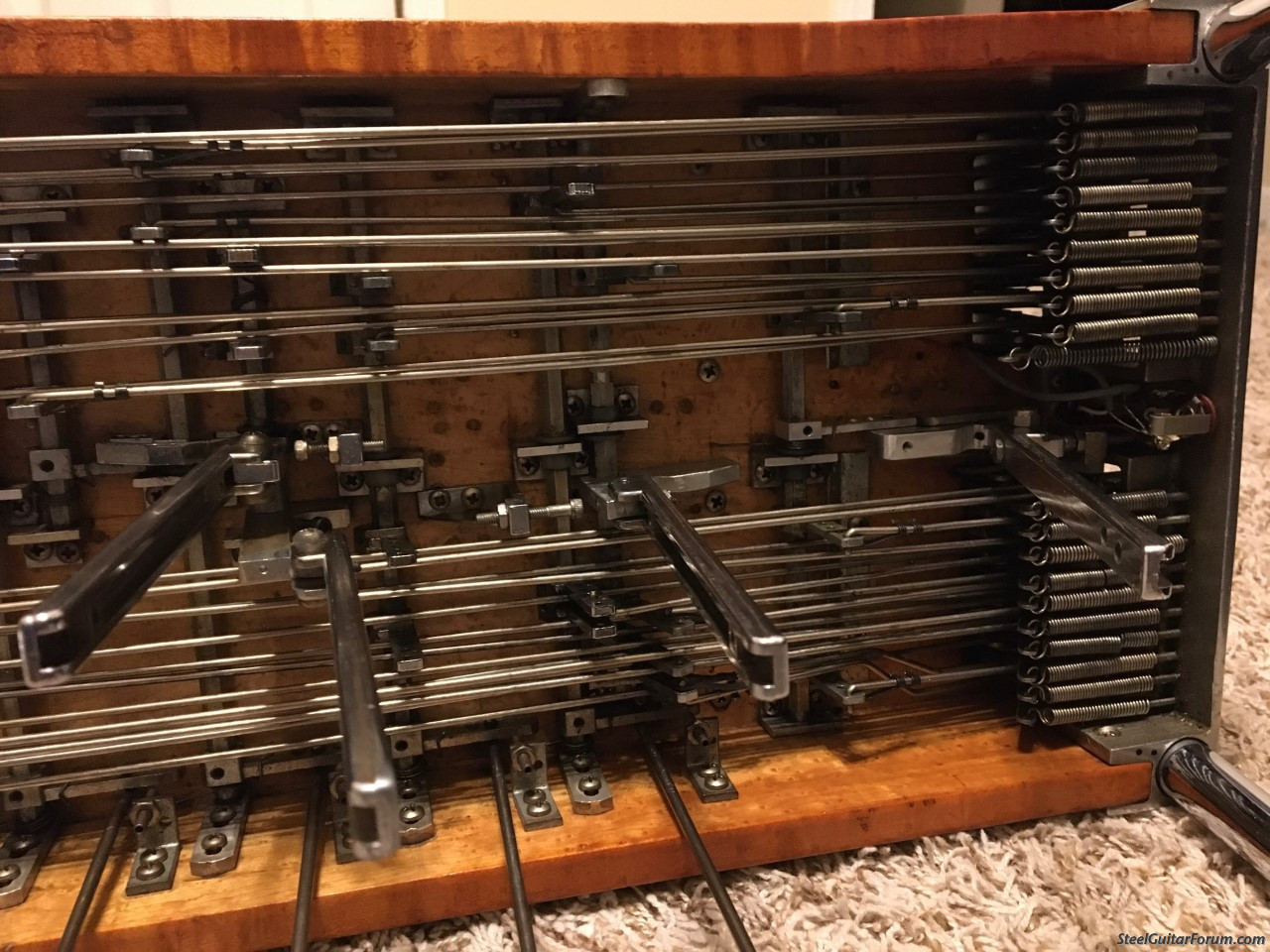
Yours look like this? I'm certainly no sho-bud expert, but I believe this is typical mechanics for an 80s Super Pro. 8 pedals, 6 knees.
3 raise/2 lower changer with conventional bellcranks and pull rods. "carburetor" clip retainers and some so-called pot metal parts on the knee levers, hubs etc.
I defer to Ricky or other Sho-Bud expert here however.
Yours look like this? I'm certainly no sho-bud expert, but I believe this is typical mechanics for an 80s Super Pro. 8 pedals, 6 knees.
3 raise/2 lower changer with conventional bellcranks and pull rods. "carburetor" clip retainers and some so-called pot metal parts on the knee levers, hubs etc.
I defer to Ricky or other Sho-Bud expert here however.
-
Ricky Davis
- Posts: 11558
- Joined: 4 Aug 1998 11:00 pm
- Location: Rocky Top Ranch, Bertram, Texas USA and Liberty Hill, Tx
- State/Province: Texas
- Country: United States
Yes Jerry is correct; that is exacly what ALL SuperPro Mechanism looks like. That is a All-Pull Nylon tuning pulling system.
Ricky
Ricky
Ricky Davis
Email Ricky: sshawaiian2362@gmail.com
Email Ricky: sshawaiian2362@gmail.com
-
Nathan Laudenbach
- Posts: 254
- Joined: 29 Oct 2015 9:39 pm
- Location: Montana
- State/Province: Montana
- Country: United States
-
Nathan Laudenbach
- Posts: 254
- Joined: 29 Oct 2015 9:39 pm
- Location: Montana
- State/Province: Montana
- Country: United States

-
Nathan Laudenbach
- Posts: 254
- Joined: 29 Oct 2015 9:39 pm
- Location: Montana
- State/Province: Montana
- Country: United States

-
Jerry Overstreet
- Posts: 14890
- Joined: 11 Jul 2000 12:01 am
- Location: Louisville
- State/Province: Kentucky
- Country: United States
Again, I defer to Ricky et al., but I believe the part in question is the half stop mechanism for string 2. That lets you tune the 2nd string from D# to C# with a half stop at D. Standard or optional perhaps on sho-buds.
The brass part is a genuine Sho-Bud barrel.
It appears to be original to me. The only thing I can't be sure of is that all Super Pros had 6 knee levers. I see 5, but there may be one folded up underneath the one in the middle.
I believe you have an original Super Pro though and from what I see, it looks like an exceptionally clean and unmolested guit, save for a couple pcs. hdwe moved or removed as witnessed from the empty screw holes.
The brass part is a genuine Sho-Bud barrel.
It appears to be original to me. The only thing I can't be sure of is that all Super Pros had 6 knee levers. I see 5, but there may be one folded up underneath the one in the middle.
I believe you have an original Super Pro though and from what I see, it looks like an exceptionally clean and unmolested guit, save for a couple pcs. hdwe moved or removed as witnessed from the empty screw holes.
-
Nathan Laudenbach
- Posts: 254
- Joined: 29 Oct 2015 9:39 pm
- Location: Montana
- State/Province: Montana
- Country: United States
-
Jerry Overstreet
- Posts: 14890
- Joined: 11 Jul 2000 12:01 am
- Location: Louisville
- State/Province: Kentucky
- Country: United States

-
Ricky Davis
- Posts: 11558
- Joined: 4 Aug 1998 11:00 pm
- Location: Rocky Top Ranch, Bertram, Texas USA and Liberty Hill, Tx
- State/Province: Texas
- Country: United States
Yes that section circled is what Jerry said. That is the half stop tuner; to tune the D note feel on the 2nd string going from D# to "D" to C#. You turn the front half of the brass barrel to fine tune that D note feel.
Have fun.
Ricky
Have fun.
Ricky
Ricky Davis
Email Ricky: sshawaiian2362@gmail.com
Email Ricky: sshawaiian2362@gmail.com
-
Nathan Laudenbach
- Posts: 254
- Joined: 29 Oct 2015 9:39 pm
- Location: Montana
- State/Province: Montana
- Country: United States

-
Dan Beller-McKenna

- Posts: 3221
- Joined: 3 Apr 2005 1:01 am
- Location: Durham, New Hampshire, USA
- State/Province: New Hampshire
- Country: United States
My Black Super Pro is also a 1981. Just got home from a gig with it; it's been my main steel for the past eight or nine years, and I can't imagine ever letting it go. Do a Forum search on "pot metal." Don't get scared off by some of the doom and gloom pronouncements. The critical parts you might consider replacing are the brackets that attach the knee levers to the cross shafts. Michael Yahl at Psgparts.com makes aluminum replacements that are easy to swap in.

-
Mike Ester

- Posts: 643
- Joined: 29 Sep 2005 12:01 am
- Location: New Braunfels, Texas, USA
- State/Province: Texas
- Country: United States
I have the same thing on my '78 Pro II:Nathan Laudenbach wrote:Now I'm not so sure if it's all original. I circled the mechanism on my Bud that I don't see on Jerrys.
viewtopic.php?t=368670
U.S.A.F. 1978-1982
2005 Carter S12U, 7x5
1978 Sho-Bud Pro II Custom D-10, 8x4
1973 Blanton D-10 #32, 8x4
If you can't be a good example, be a horrible warning.
2005 Carter S12U, 7x5
1978 Sho-Bud Pro II Custom D-10, 8x4
1973 Blanton D-10 #32, 8x4
If you can't be a good example, be a horrible warning.
-
Ricky Davis
- Posts: 11558
- Joined: 4 Aug 1998 11:00 pm
- Location: Rocky Top Ranch, Bertram, Texas USA and Liberty Hill, Tx
- State/Province: Texas
- Country: United States
Yes the "Half Stop Mechanism" was standard on most all Sho-Bud models.
Ricky
Ricky
Ricky Davis
Email Ricky: sshawaiian2362@gmail.com
Email Ricky: sshawaiian2362@gmail.com
-
Jerry Overstreet
- Posts: 14890
- Joined: 11 Jul 2000 12:01 am
- Location: Louisville
- State/Province: Kentucky
- Country: United States
-
Detlef Webert
- Posts: 166
- Joined: 19 May 2017 11:33 am
- Location: Europe - DE
- State/Province: -
- Country: United States
Hi Paul,
that's a very nice history how the Bud's have been evolved over time. I bought my Super Pro back in 1984.
Before that, I had a handmade German double-neck which was great sounding as well but I never would get rid of the ShoBud.
Is there something comparable on the market nowadays?
@ Ricky- so what's the correct order tuning the 2nd string; open, half stop (D) using the brass barrel and the Changer down to C# - endstop ?
Regards,
that's a very nice history how the Bud's have been evolved over time. I bought my Super Pro back in 1984.
Before that, I had a handmade German double-neck which was great sounding as well but I never would get rid of the ShoBud.
Is there something comparable on the market nowadays?
@ Ricky- so what's the correct order tuning the 2nd string; open, half stop (D) using the brass barrel and the Changer down to C# - endstop ?
Regards,
-
Nathan Laudenbach
- Posts: 254
- Joined: 29 Oct 2015 9:39 pm
- Location: Montana
- State/Province: Montana
- Country: United States
-
Ricky Davis
- Posts: 11558
- Joined: 4 Aug 1998 11:00 pm
- Location: Rocky Top Ranch, Bertram, Texas USA and Liberty Hill, Tx
- State/Province: Texas
- Country: United States
Detlef; Tune your 2nd string D# to C# on lower first.
Then tune your 9th from D to C# and you want that 9th string rod to pull from same changer hole and puller hole as the 2nd string; then it will engage about the time the 2nd string hits a D note. Then engage 2nd string half way feel to D and fine tune the barrel to perfect D Feel Stop.
Ricky
Then tune your 9th from D to C# and you want that 9th string rod to pull from same changer hole and puller hole as the 2nd string; then it will engage about the time the 2nd string hits a D note. Then engage 2nd string half way feel to D and fine tune the barrel to perfect D Feel Stop.
Ricky
Ricky Davis
Email Ricky: sshawaiian2362@gmail.com
Email Ricky: sshawaiian2362@gmail.com
-
Detlef Webert
- Posts: 166
- Joined: 19 May 2017 11:33 am
- Location: Europe - DE
- State/Province: -
- Country: United States
-
Lee Dassow
- Posts: 847
- Joined: 17 Mar 2010 8:01 am
- Location: Jefferson, Georgia USA
- State/Province: Georgia
- Country: United States
What was the setup on the 6 Knee Levers? Boy I like those super pro's. Tenn.Lee
2015 Mullen D-10 Royal Precision 9x8,-1990 BMI S-10 5x5-1972 Silver face Fender pro Reverb amp,-1965 Fender Super Reverb Amp,- 1966 Fender Showman Amp Two 15" JBL speakers,- 2006 65 Fender Twin Reverb reissue Amp,- 1982 Peavey Session 500 amp,-1978 Peavey Session 400,Goodrich Volume Pedals,John Pearse Steel Bars,
-
Lynn Stafford

- Posts: 2231
- Joined: 17 Sep 2002 12:01 am
- Location: Ridgefield, WA USA
- State/Province: -
- Country: United States
Super Pro Rodding Chart
Lee,Lee Dassow wrote:What was the setup on the 6 Knee Levers? Boy I like those super pro's. Tenn.Lee
Here is a standard rodding chart for a Super Pro.

Best regards,
Lynn Stafford
STEEL GUITAR WEST
http://www.steelguitarwest.com
Steel Guitar Technician (Restoration, Set-up, Service and Repair work)
Previous Emmons Authorized Dealer & Service Technician (original factory is now closed)
ZumSteel Authorized Service Technician
----------------------------------
Lynn Stafford
STEEL GUITAR WEST
http://www.steelguitarwest.com
Steel Guitar Technician (Restoration, Set-up, Service and Repair work)
Previous Emmons Authorized Dealer & Service Technician (original factory is now closed)
ZumSteel Authorized Service Technician
----------------------------------
-
Jeremy Threlfall

- Posts: 1386
- Joined: 3 Aug 2006 12:01 am
- Location: now in Western Australia
- State/Province: -
- Country: United States