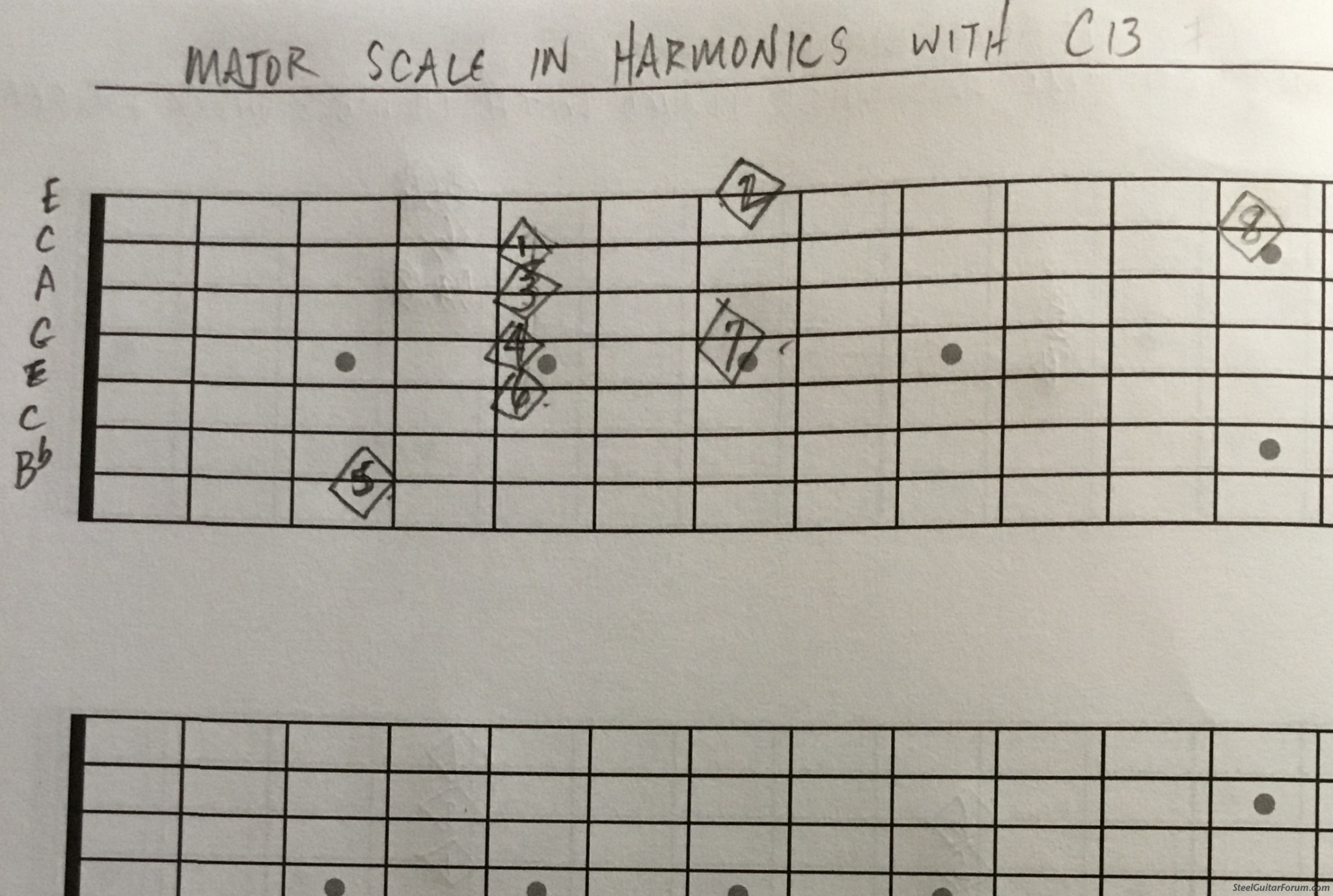
I was gifted this "Guitar Neck Diagram Notebook." https://a.co/d/6ibaLE6
What would you do with this book, and how would you organize it?
Guitar fretboard booklet - what to do?
Moderator: Brad Bechtel
-
Lloyd Graves
- Posts: 205
- Joined: 6 Jan 2020 2:07 pm
- Location: New York, USA
-
Lloyd Graves
- Posts: 205
- Joined: 6 Jan 2020 2:07 pm
- Location: New York, USA
-
David Knutson

- Posts: 484
- Joined: 25 Mar 2004 1:01 am
- Location: Cowichan Valley, Canada
-
Lloyd Graves
- Posts: 205
- Joined: 6 Jan 2020 2:07 pm
- Location: New York, USA
Thanks to whomever fixed the thread title!
I was thinking of initially using the book to write down the notes in high bass A tuning. Then using 1-2 pages to map out where all the C chord variations (C maj, C Mon, C7, etc) can be found, then do the same for all other chords. Then use the rest of the book to work on moving between chords.
Is there another workbook that you might suggest as a better alternative to do that sort of thing? I can still exchange the book.
I was thinking of initially using the book to write down the notes in high bass A tuning. Then using 1-2 pages to map out where all the C chord variations (C maj, C Mon, C7, etc) can be found, then do the same for all other chords. Then use the rest of the book to work on moving between chords.
Is there another workbook that you might suggest as a better alternative to do that sort of thing? I can still exchange the book.
-
Mike Neer

- Posts: 11494
- Joined: 9 Dec 2002 1:01 am
- Location: NJ
I use it to convey certain visualizations to students and I use it for my own personal diagrams.
Sometimes those diagrams with a hundred notes filled out can really obscure some important little visualizations that you might be able to make. I think it's best when we start seeing things for ourselves so it gets really embedded in your mind.
There was a great book by Pat Martino called Linear Expressions that utilized this kind of diagram to great effect.
Sometimes those diagrams with a hundred notes filled out can really obscure some important little visualizations that you might be able to make. I think it's best when we start seeing things for ourselves so it gets really embedded in your mind.
There was a great book by Pat Martino called Linear Expressions that utilized this kind of diagram to great effect.
Links to streaming music, websites, YouTube: Links
-
Lloyd Graves
- Posts: 205
- Joined: 6 Jan 2020 2:07 pm
- Location: New York, USA
I just did a Google search for that book and read a bunch about it, including an old SGF thread. Pat Martino sounds like some next-level stuff. And maybe a never for me, since the music I love is swing, country, Western swing and blues - all from the 1920's, 30's and 40's. But I won't say never, since the more I learn about music, the more I start liking different stuff.
I have started putting in major scales so far, as I think it's good to know which notes are okay, and it helps solidly the circle of fifths. It has also helped me start realizing that harmonized scales (diatonics 3rds and 6ths) should be my next task.
I plan to do the more conventional played scales in my life. A, Bb, C, D, Eb, E, F and G. Then minor.
I have started putting in major scales so far, as I think it's good to know which notes are okay, and it helps solidly the circle of fifths. It has also helped me start realizing that harmonized scales (diatonics 3rds and 6ths) should be my next task.
I plan to do the more conventional played scales in my life. A, Bb, C, D, Eb, E, F and G. Then minor.